Showing posts with label Creative translation. Show all posts

Tuesday, March 11, 2008

A translation that missed the boat/Pourquoi chercher midi à quatorze heures ?

I happened to chance upon Birk’s Jewellers home page recently and was pleasantly surprised by the tag line: "Sure to bring back the butterflies". The addition of a fluttering butterfly really combines the abstract and the concrete.

My translator’s curiosity made me look at the French version:

“Ravive la flamme en un battement d’aile” or word by word: “Revives the flame with the beat of a wing”

Does the sight of a butterfly revive love? I think the translator looked too far or tried to create a poetic message, forgetting that there is a very common and accepted expression

“Sentir des papillons dans l’estomac”

Il est vrai que l’expression en question n’est pas mentionnée ni dans le Petit Larousse ni dans le Robert. J’ai trouvé cependant plusieurs occurrences de cette expression sur Internet, surtout par des auteurs québécois. Interrogée sur la publicité, mon épouse (d’expression anglaise) me dit : I could have done this translation myself. En effet, le traducteur avait cherché trop loin.

Il s’agit d’une surtraduction. Est-ce que le français actuel vous fait penser au petit pincement dans l’estomac provoqué par un événement agréable et imprévu ? À vous de juger.


Friday, January 25, 2008

Advertising adaptation – and the winner is….? / Un coup publicitaire magistral


A recent trip to Vancouver took me to Grouse Mountain, a skiing spot just 30 minutes north of Vancouver. After taking in the chilly air (it was –7° C at the altitude of 1400 metres), I decided to have a snack. Here is a picture of it:

Excellent example of creative adaptation. The name of the English produit is Milk 2 Go which, to my mind, plays on the fact that this drink can be had anywhere. The French version, cunningly, plays on the similarity of the sounds Lait (milk in French) and Let’s go – an English admonition. It is the French spelling that gives away the generic name of the product (Lait), as the Canadian Consumer Labelling Act requires.

Plus je regardais l’adaptation française plus j’étais littéralement épaté par la créativité de l’expression. Je dirais même que l’appellation française est plus réussie que l’anglaise tout en respectant l’anglais, la langue dans le vent à travers le monde.

I can testify to the fact that the milk was extremely thirst quenching and the chili con carne hot and spicy. A very filling snack.


Tuesday, July 03, 2007

Bilingual tag from the States/Étiquettage bilingue en provenance des É.-U.

Translation can be a tricky thing sometimes. Here is a mandatory textile label that has an extra French message (Nous sommes desoles que notre president soit un idiot. Nous n'avons pas vote pour lui).


Cette photo date de plusieurs années mais on voit que quelqu'un chez les Ricains avait un sens de l'humour pointu.

Monday, February 19, 2007

Microsoft Vista: Not 'People Ready' - Forbes.com

Microsoft Vista: Not 'People Ready' - Forbes.com

Je parlais récemment de la publicité de Microsoft dont la devise "People ready" posait des problèmes de traduction. À juger par l'article dans Forbes, le lecteur anglais pourrait également avoir des problèmes de compréhension.

I guess I was not very far off the mark when I stated that the meaning of the People Ready tag line could be interpreted in several ways. I appears as though Daniel Lyons of Forbes could not quite figure out what Microsoft meant.

Wednesday, January 24, 2007

Our business is folding (?!?!)

As I was driving on the Highway 401 in Toronto this morning, a panel truck passed me which bore on its side the company name (or tag line?):

Our business is folding

with underneath, a picture of a multifolded piece of paper.

My translator’s mind started to speculate what one have to do to create a French equivalent. If the motto is always used with the illustration, the meaning is quite clear; one could say:

Le pliage, c’est notre affaire! (Folding is our business!)

If, on the other hand, it is a company name which is not always accompanied by the graphics, the English becomes more difficult to understand. Imagine the receptionist answering your call and saying: “Our business is folding”, Jennifer speaking.”

It is the other meaning of folding which bothers me – is this business closing its doors?

There is often a play on words in marketing and advertising, which may be be quite successful in one language and one culture but which cannot be duplicated in another.

Translation is all context and that means not only language but culture, social milieu and country. Things which would be successful here can be a disaster in Europe and vice versa. It is like the story of the Mist Stick hair curler, which, in German, became the manure stick (since one meaning of mist in German is manure!)

Thursday, December 14, 2006

MICROSOFT PEOPLE READY/Publicité boiteuse


When Microsoft started running its People Ready advertising, I wondered immediately how they would get around the French equivalent. In my experience with an international company, we often had problems rendering a vague idea into French. Consider the tag line “It’s time”. At the beginning, it referred to the fact that it was the right time to purchase a new automobile. Then, in the subsequent years, different meanings were attributed to the words and the French creative people ran into problems of finding the equivalents (there were none to be found).


Another time, emphasis was placed on a device in the trunk of a car that would allow a small child trapped in it, to open it from the inside. I remember a whole booklet being put together where in addition to the copy, a drawing of an elephant trunk, was used. That is what killed the French. Indeed, “tronc” is the appendage of the elephant but “coffre” is the box into which one can place luggage, etc. The play on words just was not possible. You can image how lame the booklet was.

Today, I opened a French magazine (L’Actualité) and found a full-page Microsoft ad, in perfect French, which read as follows:


« Dans une entreprise people XX ready, le marketing et l’ingénierie sont sur la même longueur d’onde. »


In English, people ready appears to be a play on words. My understanding of it is that people are or become ready (and therefore productive) if they are provided the right tools (Microsoft). It took me several repeated readings of the English text to understand the message.


Why does Microsoft think French speakers (and readers) in
Canada would understand the idea of “People ready” when it was left in English. If I had taken a complete French sentence and inserted an English colloquialism in the centre of it, how many French speakers would understand it?

Here is what the ad says:

« Des employés unis par des données sont des employés unis. Microsoft. Des logiciels conçus pour les entreprises où les employés sont toujours prêts. Microsoft.ca/peopleready. »


Is there a difference between people ready and ready people? There certainly is in my mind.


Bilingual creative advertising is always the result of cultural and linguistic consultation. That is why most of the ads in
Quebec are rewritten in the French context, using French themes, and personalities. Microsoft fell asleep at the wheel.

Sunday, December 03, 2006

English Advertising/Italian song/French translation


Some time ago, a new client asked me to translate the packaging copy for one of his famous chocolate cakes. The approach was to liken chocolate to love and the vehicle used were the famous lyrics from the song “Amore” , by Dean Martin (and Perry Como fame):

"When the moon hits your eye/Like a big-a pizza pie/That's amore", "When the stars seem to shine/Like you've had too much wine/That's amore", and "When the stars make you drool/Just like pasta fazool'/That's amore."

Another panel extolled the virtues of the chocolate, using Jewish humour.

The song was well-known in Canada and in Quebec in the 50’s but appeared to exist only with the English lyrics. Translating the lyrics into French might have been a solution but the translator did not feel sufficiently qualified to write poetry in French. Using English lyrics on the French panel also felt like a no-no.

What absolutely stymied me is how to render English-Jewish humour in French (for the Montreal market).

I called the client, explained my predicament and suggested that the copy be reworked. He was disappointed and thanked me for my opinion. Several days later, he called me, thanked me for my comments and told that he had spoken with a very good, bilingual friend in Ottawa who had totally agreed with my opinion.

The translation was not done but I still had a grateful client who thanked me for helping him avoid a cultural and linguistic faux pas.

Wednesday, November 08, 2006

Adaptation is more than translating/ L'adaptation dépasse la traduction


In 1982, Tom Peters and Robert Waterman wrote the influential book "In search of excellence" which created new approaches to business. The book served as an inspiration to many companies and its title was used for many different programs aimed at improving sales.

When GM used the title as a tagline, a challenge presented itself for the Quebec market. A translator will always look for the "official" rendering of a book in another language. I thus discovered that the book had been translated in France by "Excellence intégrale".

It was thus decided that this tagline would be used on nametags connected with this particular sales activity. I remember witnessing the meeting of two sales people, one English and one French: the French one looked at his colleague's nametag and said "you are still looking for excellence, we have found it"!

This is a typical example of the French "way of seeing things", usually as a final result, not as a process. As long as the two titles are not set side by side, each one is ok. Side by side, they can create misunderstandings.

C'est pour cette raison que lors de l'élaboration d'un slogan pour le Québec, je le crée toujours à côté de l'anglais, pour m'éviter des surprises comme L'excellence intégrale. Ainsi, pour un récent client, j'ai trouvé l'équivalent suivant :

XX company delivers more than ideas, we deliver results

La XXX : plus que des idées, des résultats


Notez la disparition des verbes et du "we".


Pour indiquer que les clients du client sont également ceux du propriétaire du site Web, j'ai modulé

ABCD: Recognized by your customers

par

ABCD : Vos clients sont nos clients!

Friday, April 28, 2006

Spring vs. Springtime explanation

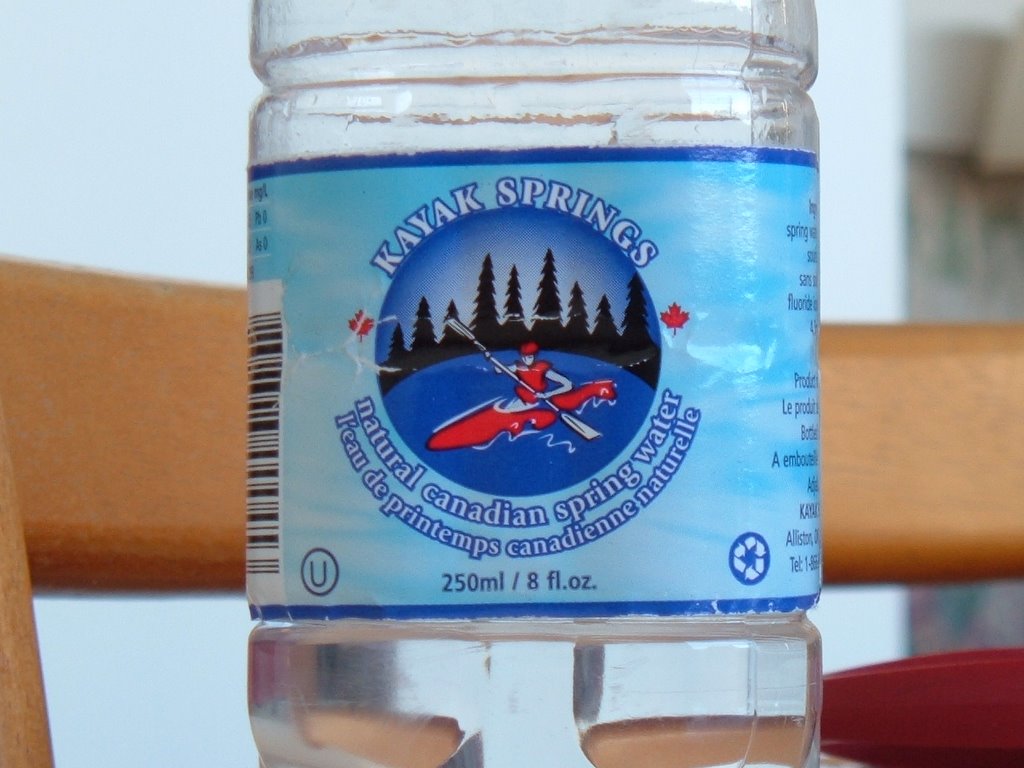
An English speaking colleague has asked me to explain the problem with the Spring translation. The word spring has several meanings in English: the noun can mean a place where a river is born, or the river itself, a season of the year, or, in the technical world, a helical device that changes shape (like the springs in your mattress).

While I do not know what the translator actually understood, he/she obviously chose the wrong equivalent. This most likely happened because of his lack of knowledge of English.

This has consequences not only for the translator but for the supplier of the water and Air Canada, who chose to purchase mislabeled merchandise. A French speaking customer may deduce that the airline's committment to bilingualism is not genuine and decide, next time, take another airline.

As they say, "Get it right the first time".

Wednesday, April 26, 2006

Origin of water served on Air Canada


A colleague of mine sent me this picture taken on a plane coming back from China. I suppose the bilingual requirements were met but somehow the meaning escaped. Has anyone seen it?

P.S. In case the type is too small, the product name says Eau de printemps canadienne naturelle/Natural Canadian Spring Water.