Showing posts with label Translation 101. Show all posts

Thursday, January 24, 2013

IT interference – Faux-sens causé par l’informatique


It is amazing to see how computer vocabulary is starting to interfere with everyday language. This morning, while ordering my coffee at my favourite shop, I noticed a wrapped cookie the description of which, in English, was very plain: Chocolate chip, it said, while the item could be seen through the wrapper.

Il est étonnant de constater comment le vocabulaire de l’informatique peut influer sur la langue quotidienne. Ce matin, en achetant mon café au restaurant du coin, j’ai remarqué un biscuit dont l’emballage transparent, en Anglais, était très clair : Chocolate chip. 

The French equivalent made me laugh. The word chip, meaning in this context a small piece (of chocolate), had been translated by the word “puce”. For a non-French speaker, that would seem odd since the ordinary meaning of puce is “flea”, like flees on a dog. In the computer world, this word also means an electronic chip.

La version Française ma fait éclater de rire. Le mot chip, c’est-à-dire, éclat ou petit morceau, avait été traduit par le mot « puce », choix bizarre pour un Francophone, qui le prendrait pour cet insecte désagréable que l’on trouve parfois sur les chiens.  Mais dans le vocabulaire de l’informatique, il s’agit également d’un élément d’un circuit intégré. 

The translator (?) took puce to mean a small piece where in fact it refers to a computer chip, not knowing either word. I hope the French –speaking consuming public will not think that they will turn itself into some computer device by eating the cookie.

Le traducteur (?) a confondu le mot puce (insecte) avec le mot puce (circuit intégré). Apparemment ile ne connaissait  ni l’un ni l’autre des deux sens.  J’espère que le public francophone ne va pas s’imaginer qu’il se transformera en une espèce d’ordinateur en mangeant ce biscuit.

P.S. C'est le terme "pépites" qu'il aurait fallu utiliser ici.  
The proper French word is "pépites", literally nuggets (cooking vocabulary).

Thursday, April 05, 2012

Investor information/Information destinée aux épargnants.


Received recently a letter to investors which contained this sheet. J’ai reçu récemment un communiqué destiné aux épargnants  accompagné de la feuille suivante:


Voici une comparaison du message de la langue de départ et d’arrivée. Here is a chart of the source and target languages:

Original English
Supplied French Translation
Actual French says
Suggested re-write
Texte de départ anglais
Traduction française proposée
Traduction anglaise du texte français
Remaniements suggérés
One day, you may have to find a new use for your blue box.
Demain, votre boîte de recyclage pourrait avoir tout un autre usage!
Tomorrow, your recycling box may have a totally new usage.
Un jour, il vous faudra trouver un autre usage pour votre boîte bleue.
You can receive your investor information from us via the Internet, so you will have no documents for your blue box.
Inscrivez-vous afin de recevoir l’information destinée aux épargnants par Internet et vous ne recevrez plus dorénavant de documents dans votre boîte blue.
Register to receive investor information by Internet and you will never again receive documents in your blue box.
En effet, vous pouvez obtenir de nous par Internet vos informations d’épargnant, éliminant l’utilisation de la boîte bleue.
It’is easy, convenient, secure, and private.
C’est facile, pratique, privé et sans danger.
This is easy, convenient, private and without danger.
C’est facile,commode, sécurisé et privé.

The words on a yellow background show the deviations from the original English. Les mots surlignés en jaune représentent les divergences de l’anglais.

Would you say that the original translation reflects the original English?  Does it say the same things, in the same way, without embellishments or “adjustments”?  Diriez-vous que la traduction d’origine reflète l’original anglais? Dit-elle la même chose, de la même manière, sans ornementation ni ajustements?

Obviously, the author of the original English thought he/she was getting an accurate translation.  Il semblerait que l’auteur du texte anglais d’origine avait pensé qu’on lui avait fourni une traduction fidèle.

Friday, March 12, 2010

Eastern Daylight time/heure avancée de l’est


This is the time of the year when we switch to the Eastern Daylight time; this led me to ponder how this is expressed in French and the possible reasons.  First of all, I should note  that in Canada, the “Daylight” expression is not rendered in French in the same way – we say Eastern advanced hour. The two settings are Daylight time and Standard time, rendered in French as heure avancée and  heure normale, literally advanced time and normal time. Ensoleillement is the French word for “daylight”.
A play on words in English is often used to remember when to move clocks ahead and when to move them back. It is “Spring forward and Fall back”. It is an amazingly clever play on words where Spring the season, becomes spring the verb – i.e. jump forward. In the same way, the season Fall, becomes fall the verb meaning to drop or move in a specified direction.
A search of French literature on this subject shows that in Canada, newspaper writers say “reculer les montres”  i.e. set back watches, where it is actually the time shown on them that is set back. In a French Swiss article, I found “les montres ont reculé d’une heure” (clocks moved back one hour). Other sources, primarily from France, appear to favor the verb “retarder”. One would therefore say avancer les montres ou horloges et retarder les montres ou horloges.
I remember reading in several translation manuals that English typically appears to favor a concrete approach to express many things: move back the hands of the clock whereas French would say avancer une montre d’une heure ou retarder une montre de 15 minutes.
I would almost think that “reculer les montres” is an error described as “anglicisme de structure” i.e. a sentence using French words but with an English sentence structure.  An online Internet dictionary provided the following German: “eine Uhr zurűckwerfen”, when it refers to time, which sounds like “throw back a clock”. What do you think?

Wednesday, April 23, 2008

Healthy Canadians – Canadiens en santé

An ad in a recent issue of the Globe and Mail drew my attention to a new Government of Canada website called Healthy Canadians. It explains the various pieces of legislation the government is planning to protect the health of Canadians.

My translator’s curiosity made me click the word Français of the home page to discover that Healthy Canadians had been rendered as Canadiens en santé – which is nonsense! Let me explain. The English adjective healthy connotes three qualities: possessing good health, conducive to good health (healthful) and indicative of sound, rational thinking or frame of mind.

The French word santé means health i.e. the physical or mental condition of a human being. It is a neutral word as it is not positive or negative. Healthy on the other hand connotes that the person is not sick i.e. en bonne santé. If one speaks of the body, skin or cell, one would say un corps sain. Another meaning of healthy is thriving in which case the French would be sain as well.

Ce qui me bouscule dans cette affaire c’est que quelqu’un a décidé que l’expression « en santé » veut dire en bonne santé, ce qui n’est pas du tout le cas. Votre épouse vient de se faire examiner par son généraliste qui la trouve en parfaite santé – lui dira-t-il : Madame, vous êtes en santé? (you are in health – word for word translation). You watch your diet and the foods you eat – proteins, carbohydrates, fats, etc. – you follow a healthy diet. En français, c’est un régime sain que l’on suit.

Un magazine publié par un hôpital ontarien a pour titre Femmes en santé. On aurait peut- être dû dire «Femmes en bonne santé », surtout lorsque l’on nous apprend que l’anglais était « Women’s Health Matters ». Au moins cinq traductions possibles : La santé des femmes, ça compte; La santé des femmes est importante; Informations sur la santé des femmes; Santé des femmes; La santé pour les femmes.

On peut imaginer le scénario : le traducteur du site web fédéral s’aperçoit que quelqu’un a déjà dit en santé pour exprimer l’idée de healthy. Alors on continue – que cela soit du français ou du franglais! The cookie cutter approach to titles and headings says we have two words in English, find two words in French. This is similar to the recent Ontario Yield to Bus legislation, which was designed to improve transit flow and make transit service more reliable and efficient.

The French text of the Highway Traffic Act speaks about “ Nécessité de céder le passage à un autobus sortant d’une voie d’arrêt d’autobus.” Earlier (in article 136), the Right of way at intersections without a stop sign is described as Priorité. That would have been the right word to use for Yield to bus. No, instead, the French came out as Cédez!

Véhicule prioritaire (or véhicule à priorité) would have been more idiomatic.

Sentence structure and word sequence are definitely part of each language – they are most often not the same in English and in French. The true test of translator is to find the idiomatic equivalent of the source expression and transpose it into the target language.


Tuesday, October 23, 2007

A translator in heaven / Le paradis des traducteurs

Dans le cadre d’un important travail, j’ai eu l’occasion d’assister à une réunion d’une journée entière sur la fabrication des contenants en verre. Notre groupe avait précédemment étudié d’autres formes d’emballages – plastiques flexible et rigide et les emballages en carton ondulé, mais c’était mon premier contact avec le verre.

Basing my recommendations on my previous work, I was able to convince my employer to allow me to attend these meetings during which experts explained the various facets of their operations and processes. A translation well done is based upon the translator’s knowledge of the language but also on his familiarity with the subject matter.

Avoir l’occasion d’écouter les présentations et poser des questions représente une ambiance idéale pour un traducteur. Plus tard, il y aura également la possibilité de faire valider ma traduction par les gens sur place, les utilisateurs des processus et auxquels est destiné mon travail.

Wednesday, September 19, 2007

Getting the technical information/Documentation technique

A recent project presented an interesting challenge: the manufacturing processes resembled those of processes in an allied industry but dealt with a different form of product. I am referring to packaging made from flexible and hard plastic, paper and now metal.

En plus de l’apprentissage que j’ai du faire dans chacun de ces matériaux, j’ai dû en plus “apprivoiser” les techniques particulières aux emballages faits de matériaux différents.

J’ai réussi à faire valoir au client qu’une série de visites dans les usines correspondantes serait d’une grande utilité. J’ai eu donc l’occasion d’observer la fabrication de sachets (pour poudres alimentaires, par exemple), puis de bocaux ou de flacons rigides et finalement d’emballages en carton ondulé.

L’accumulation de ces connaissances a porté ses fruits: ce matin, lors d’une visite d’une conserverie, j’ai pu observer les mêmes éléments et les mêmes étapes qu’avec les autres matériaux. Des expressions qui m’avaient semblé opaques sont devenues claires et nettes. Je pourrais les utiliser en toute confiance avec les destinataires de ma traduction.

Translation requires several pieces of knowledge: the language, of course, but also the field or area of expertise that is being described. Thanks to this understanding client, I will have both.

Thursday, May 24, 2007

Downloadable articles / Articles téléchargeables

A recent HPCA networking session covered the very interesting topic of articles that customers/readers can download. They may be informercial or explanatory types or they may be case studies. I decided to poll you, my readers, to find out whether you would be interested in reading articles on translation such as the one I recently wrote on “Culture in translation”.

L’utilité des articles d’information est évidente mais c’est la façon dont les clients/lecteurs les obtiennent qui m’intéresse. Mes démarches pour trouver la façon de le faire sur mon blogue n’ont rien donné jusqu’à présent. Je demande donc aux intéressés de m’envoyer un courriel au translationbeyondwords@sympatico.ca avec leurs coordonnées et je leur ferai parvenir mon article.

If such an article is of interest, please send me your contact information at the above address and I will gladly e-mail it to you.

Wednesday, April 04, 2007

Misleading headings/Titres bizzares

I have noticed that newspaper titles are used in many different ways, especially when they serve as a link to the story. I was somewhat taken aback this morning when I found a heading on the Globe & Mail website that said:

Building permits plunge.

A bit intrigued, I clicked the title and lo and behold found:

Building permits plunge

Canadian building permits unexpectedly plunged to their lowest level in a year, paced by declines in Toronto and Vancouver, as the weather turned colder…..

So it was not an animated building that decided to try the waters.

On the French side of things, on the CBC especially, the Google and MSN transcribers have a rough time. French titles are usually preceded by a qualifying statement, for example: Vie sociale – De l’importance de votre cortex. Without the explanation, the title is much harder to understand.

Another one was: Crise politique en Ukraine – Le premier minister tend la main au président. On a referral French page, only the second (main) title is shown: The prime minister reaches out to the president. Could it be Harper and Bush? Without the word Ukraine, any guess is ok with this little context.

Reminds me of the classical heading translation example:

“PROFESSOR BURNS LEAVES ON COMMENCEMENT.” The all-cap approach conceals the fact that Burns is a proper name, not a verb. You can image what a beginner translator might do with this and describe a new ritual of burning leaves at a graduation.

Context is everything in translation. Make sure you provide all of it to the translator you hire – otherwise, he too might take the plunge.

Sunday, April 01, 2007

Diagramme de cause à effet pour la traduction


Back in May of last year, I posted this translation fishbone diagram but failed to provide a French version - here it is.

Voici la version française de mon diagramme de cause à effet sur la traduction. J'ai découvert que mes clients industriels comprennent mieux ce genre d'explication que des explications écrites.

Wednesday, March 07, 2007

Cultural interference in languages/Interférence de la culture dans la langue

When American companies started using the Best before formulation on food and food packaging, the world took notice and little by little, the same formulation appeared elsewhere. Thus, when the Canadian authorities set about implementing this system, they went with

Best Before and in French - Meilleur avant

While in English, one can use a comparative without formally mentioning the two compared products, according to French grammar, the two things compared must be mentioned. (so to a Frenchman or someone from another French-speaking country, this expression sounds somewhat strange).

In English, the sentence does not say This product is best before. There is also no explanation of what best means.

On packages from France, the DLC acronym is used; it stands for Date limite de consommation (deadline for consumption, i.e. should be eaten before…). The French is much more categorical – one should not eat the product after a certain date. It is like saying this passport expires on….. So it is not valid after that date.

A similar confusion is found with the Yield to Bus Act enacted by the Province of Ontario in 2004. Here is an explanation of how this works:

“When a bus displaying the Yield to Bus sign signals its intention to leave a bus bay by activating the left turn signal, drivers approaching from the rear in the lane adjacent to the bus bay are required to slow down or stop to allow the bus to re-enter the lane, unless it is unsafe to do so.”

So the original idea is to yield the right of way, or yield in short. The verb céder in French has somewhat different meanings:

- to give up (to let somebody have something)

- to sell or dispose of

- to give way to somebody (céder le pas à quelqu’un)

- to give in (sa mère lui cède en tout – his mother always gives in to him)

In the language of driving legislation, one speaks of “donner la priorité à quelqu’un”, to give someone the right of way.

Unfortunately, both Meilleur avant and Cédez are here to stay and the public at large has come to recognize and understand these expressions. The astute translator will have to take into account the culture of the end-reader and convey the expression in that reader’s understanding.

Tuesday, February 06, 2007

Ethical translation/Conscience professionnelle


It is always tempting, especially for a translator in private practice, to accept work outside of his field of expertise; what businessman would pass up lucrative work! I am sure that many other professionals have to deal with the same dilemma.

Some years ago, an apprentice translator (who had just started translating) after a career in another technical field, boasted to me that he was doing translation about atomic reactors (he was in aeronautics previously). I was astounded to say the least and did express my concern that he may not always understand what he translates and he said “Yes”!

The Code of Ethics of ATIO, organization that I belong to since 1971, specifically states that:

“Members shall not accept work for which they lack the necessary qualifications. In accepting work, the member provides a moral guarantee that the service provided will meet the highest standards of quality”.

For various reasons, he never became a member of the ATIO, which was a relief to me.

Do you quiz your translator about his expertise, his experience, and his track record BEFORE hiring him to do work for you?

Tuesday, January 23, 2007

Machine translating a heading/Traduction machine d’un titre

The following heading appeared on an Internet business website:

US factory orders jump

Using machine translation, the French equivalent by the LDS engine was as follows:
1) Les ordres d'usine d'États-Unis sautent

Using the Altavista translation engine, the following was provided :
2) Saut d'ordres d'usine des USA

Two vocabulary mistakes first of all :

1) the French word for order (meaning a promise to buy) is called commande.

2) Whereas in English jump may mean a) to spring clear of the ground, to leap; b) to rise suddenly; c) to rise suddenly in amount, price, etc., the verb sauter means to jump(a), to blow up or to fry. So the French can be read as United States orders blow up (?!)

To express the idea of a sudden increase implied in the verb jump, we could say augmentent soudainement. The syntax or word order and grammar in translation #1 are not correct: we could say instead

Les commandes des usines

since these are orders from many factories, not just one, and to show the country where this takes places, we would say

Les commandes des usines aux États-Unis.

So putting everything together, we would get

Les commandes des usines aux États-Unis augment soudainement.

One notices that sentence #2 just changed the word order and substituted orders jump with jump in orders. Otherwise, still the same ordrer/commande error as well as the jump/augmentent error.

Moral of the story: beware of machine translation if no native speaker is handy to touch up the results. You might offend the reader and lose a customer – is it worth it?

Monday, May 01, 2006

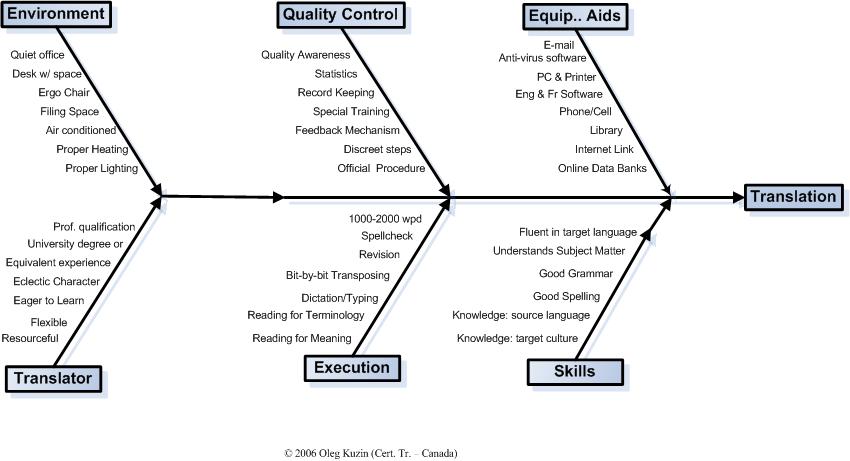
Translation Fishbone Diagram


Business people, especially those familiar with
manufacturing and production, understand process charts and cause and effect charts. That is reason why I put this chart together which attempts to show the various elements that enter into a translator's work.

An exercise such as this helps to refine a process
and illustrate every discrete part of it. I hope that my detail oriented readers will enjoy it.

P.S.. I have found how to perform a spellcheck while writing this Blog. Please ask me for details. To enlarge the diagram, double click on it.